Every commercial construction firm possesses three identity coordinates that the entire local search ecosystem uses to verify its existence: Name, Address, and Phone number. Together, these three data points form the NAP triad—the foundational identity fingerprint that Google cross-references across hundreds of directories to determine whether your business is trustworthy enough to appear in high-value local searches. When even one of these three coordinates deviates across any platform on the internet, the algorithmic consequences are immediate and financially devastating.

The Three-Point Identity Protocol
In commercial construction, your firm's identity is more than a logo or a tagline. At the algorithmic level, your business identity is reduced to three austere data points: the exact legal name under which you operate, the precise physical address of your registered office including suite and floor designations, and the primary business phone number that serves as your first point of institutional contact. These three coordinates—and nothing else—constitute the NAP triad that every search engine, mapping platform, voice assistant, and business aggregator uses to validate your corporate existence.
The concept appears deceptively simple. How difficult can it be to keep three pieces of information consistent? For a small residential handyman operating from a single location with one phone line, the answer is: not very. But for a multi-division commercial general contractor with a 15-year history, multiple office relocations, a corporate rebranding cycle, several DBA transitions for subsidiary project entities, and phone system migrations across different telecom providers—the answer is: extraordinarily difficult. And the consequences of failure are not administrative inconveniences. They are direct, measurable, ongoing financial losses running into the millions.
The algorithm does not understand context. It does not recognize that "Apex Builders LLC" and "Apex Construction Group LLC" are the same company that merely updated its corporate name during a 2019 reorganization. It treats those as two distinct entities competing for the same geographic territory. And when it detects that Entity A has 83 citations listing "Suite 200" while Entity B has 47 citations listing "Suite 210" because you moved one floor up in 2021, it fractures your aggregate authority across both phantom entities rather than consolidating it into one dominant profile.
How NAP Fragmentation Propagates
The internet's business data infrastructure operates on a cascading distribution model. At the top of this hierarchy sit four primary data aggregators—Data Axle, Neustar Localeze, Foursquare, and Factual—that function as wholesale distributors of business identity information. When you register or update your business data with these aggregators, they broadcast that information to hundreds of downstream platforms: Google, Apple Maps, Bing, Yelp, The Blue Book, Procore, local Chamber of Commerce databases, and thousands of smaller niche directories.
The critical vulnerability in this system is that once incorrect data enters an aggregator, it replicates automatically and indefinitely. If your firm changed its primary phone number in 2022 but failed to update the change at the aggregator level, the old phone number continues to propagate to new directories being launched, to existing directories refreshing their data, and even to voice search platforms that pull their business listings directly from aggregator feeds. The error does not decay over time. It compounds. Every week that passes, the corrupted data spreads further, creating an ever-widening gap between your actual corporate identity and the identity that the algorithm believes to be true.
The Propagation Multiplier
A single uncorrected phone number at one aggregator can generate 40 to 80 downstream citation errors within 90 days. Each incorrect listing acts as an independent negative trust signal to Google. By the time you notice that your local search rankings have declined, the damage has already metastasized across scores of platforms. Reactive correction at the directory level is futile—you must correct the source aggregator data first, then wait 4 to 12 weeks for the corrected data to cascade through the ecosystem.

The Taxonomy of NAP Errors
Not all NAP errors are created equal, and understanding the hierarchy of severity is critical for triaging remediation efforts. Name inconsistencies are the most destructive because they directly challenge the algorithm's ability to identify your firm as a singular entity. "Apex Commercial Builders" versus "Apex Commercial Builders LLC" versus "Apex Construction Group" versus "ACB General Contractors" may all refer to the same company in your mind, but to the algorithm, each variation is a potentially separate business entity competing for the same geographic territory.
Address inconsistencies rank second in severity. The most common culprits are suite number changes after an office relocation, formatting discrepancies between "Ste 400" and "Suite 400" and "#400", abbreviated street names versus spelled-out versions ("St." versus "Street"), and the inclusion or omission of secondary address lines. While individually minor, these discrepancies accumulate into a pattern that the algorithm interprets as geographic instability—a signal that your business may not have a reliable, permanent physical presence.
Phone number inconsistencies, while the least damaging in isolation, create a uniquely disruptive vulnerability: they enable competitors to intercept your leads. When a potential client calls a disconnected number listed on an outdated directory, their immediate next action is to return to the search results and call the next firm listed. Your competitor has just acquired a qualified lead that originated from your own corrupted digital footprint. This is not a theoretical risk; it is a scenario that plays out hundreds of times daily across the construction industry.
NAP Error Severity Matrix
- Critical — Name Variations: Different legal names, missing or added suffixes (LLC, Inc.), DBA mismatches. Directly fragments your entity authority.
- High — Address Discrepancies: Old suite numbers, formatting inconsistencies, missing secondary lines. Signals geographic instability to the algorithm.
- Moderate — Phone Mismatches: Disconnected lines, toll-free vs. local numbers, old fax lines listed as primary. Enables direct lead interception by competitors.
The Systematic NAP Consistency Check Protocol
Executing a rigorous NAP consistency check begins with establishing your authoritative Master NAP Record—the single, canonical version of your business name, address, and phone number exactly as they should appear across every directory on the internet. This is not a creative decision; it is a technical specification. The name must match your state corporate registration exactly, including punctuation and legal suffixes. The address must use the exact formatting recognized by the United States Postal Service's Address Management System. The phone number must be the primary inbound line that routes to your business development team, not a fax line, not a temporary project phone, and not a personal mobile number.
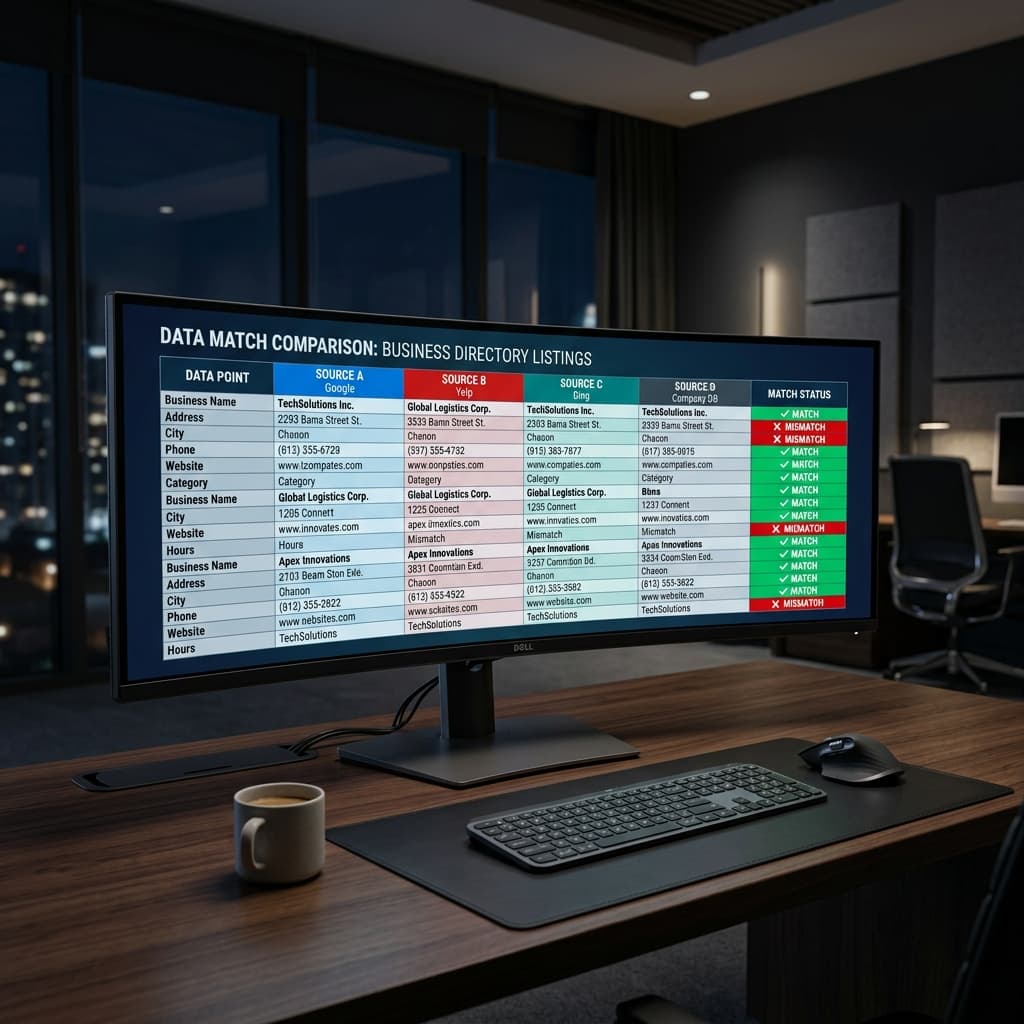
With the Master NAP Record established, a professional consistency audit then proceeds to systematically scan the four major data aggregators, the five Tier 1 authority platforms (Google Business Profile, Apple Maps, Bing Places, Facebook, Yelp), all industry-specific construction directories relevant to your vertical and geography, and every secondary directory and niche listing that appears in a comprehensive business data scan. Each discovered citation is compared character-by-character against the Master NAP Record. Any deviation—even a single character—is logged, categorized by severity, and queued for remediation.
Remediation Architecture: Top-Down Correction
The cardinal rule of NAP remediation is: always correct from the top of the data distribution hierarchy downward. Updating your listing on an individual directory while leaving the source aggregator data unchanged is worse than useless—it is a waste of resources that will be automatically overwritten when the aggregator next pushes its data downstream. Professional remediation campaigns begin by submitting corrected Master NAP data to all four primary aggregators simultaneously, then monitoring the downstream propagation over a 4 to 12-week period to verify that corrections have cascaded successfully.
During the propagation window, the remediation team addresses Tier 1 platforms directly. Google Business Profile, Apple Maps, and Bing Places each have their own independent data correction workflows that operate outside the aggregator cascade. These platforms must be updated manually through their respective business owner verification portals. Facebook and Yelp require separate claims and edits through their own administrative interfaces. Each correction is documented and timestamped in a centralized tracking system that maintains a complete audit trail of the remediation campaign.
The third phase targets industry-specific directories that are critical for commercial construction firms. The Blue Book, Procore, ENR, Dodge, and regional AIA chapter directories each have unique editorial processes and verification requirements. Some accept online submissions; others require formal written requests or direct phone calls to editorial staff. A professional remediation agency maintains institutional relationships with these platforms specifically to accelerate corrections that would otherwise languish in multi-week review queues.

The Ongoing Maintenance Imperative
NAP consistency is not a one-time project. It is an ongoing operational discipline that requires quarterly audits and continuous monitoring infrastructure. The business data ecosystem is inherently dynamic. Aggregators periodically refresh their databases from multiple sources, and if any legacy source still contains your old data, your corrected information can be re-corrupted without warning. New directories launch continuously, often pre-populating their listings from aggregator data that may be weeks or months out of date. Competitors can suggest edits to your Google Business Profile. Former employees with access to old directory accounts can inadvertently modify listings.
Elite commercial contractors treat NAP monitoring with the same operational seriousness they bring to safety compliance or financial auditing. They install automated monitoring tools that scan their citation landscape on a weekly cadence, alerting their marketing team the moment any directory listing deviates from the Master NAP Record. They conduct comprehensive quarterly audits that include manual verification of every Tier 1 platform and a randomized sample of secondary directories. They maintain a documented change management protocol that requires any corporate identity change—office relocation, phone system migration, legal name amendment—to immediately trigger a full NAP update cascade across all aggregators and priority platforms.
The firms that execute this discipline consistently are the ones dominating the Local 3-Pack in competitive commercial construction markets across California. They have not won that position by having superior construction capabilities or larger portfolios. They have won it by engineering the most mathematically pristine digital identity in their geographic market. Their NAP data is identically consistent across 300 or more citation sources, creating an overwhelming algorithmic consensus that their business is real, active, verified, and physically rooted in the exact coordinates where high-intent developers are searching. That mathematical certainty is what forces the algorithm to rank them above firms whose fractured data profile communicates unreliability.
Unify Your Data. Dominate the Algorithm.
Lemonade Ideas executes institutional-grade NAP consistency audits for elite commercial contractors. We scan every aggregator, every directory, and every citation source to identify and surgically correct every data point that is silently destroying your local search authority.
Deploy NAP Integrity