The commercial construction industry operates under a deceptively simple digital principle: your firm exists, on paper, in hundreds of locations simultaneously across the internet. Business directories, contractor databases, municipal procurement portals, trade association registries, and mapping platforms each hold a separate, independent record of your corporate identity. When those records contradict each other, the Google algorithm classifies your business as a high-risk, unverifiable entity—and systematically removes you from the local searches that generate eight-figure bids.

What Is a Citation, and Why Should You Care?
In the context of local search intelligence, a "citation" is not a legal document or a government fine. It is every instance across the public internet where your business name, physical address, and primary phone number appear together. The industry term for this triad is NAP: Name, Address, Phone. Each combination of these three data points scattered across the internet constitutes a separate citation. Google, Bing, and every major search engine use automated crawlers that roam the entirety of the public web, collating and cross-referencing every one of these citations in real time to build a composite trust score for your corporate entity.
For a commercial contractor with a decade of operational history, the number of citation instances across the internet can easily surpass several hundred. Every time your firm was mentioned in a press release, listed in a subcontractor network, indexed by an auto-populating business aggregator, or registered in a Chamber of Commerce directory, another citation was created. Each one of these records is a permanent fixture of the internet's institutional memory, and each one has the capacity to either reinforce or actively destroy your algorithmic authority.
The brutal reality is this: the vast majority of large commercial contractors have never executed a single, systematic review of their citation landscape. They have been building their business for fifteen years, rebranding once, changing office addresses twice, updating phone lines during a telecom transition, and rotating DBAs across multiple subsidiary projects. The result is a digital ghost story—a fractured, contradictory mosaic of corporate identity data that the algorithm reads as institutional chaos. And institutional chaos is the death sentence for local search visibility.
How the Algorithm Penalizes Inconsistency
Google's local ranking algorithm processes citation data through an extremely sophisticated probabilistic validation framework. When the system aggregates the hundreds of citations attached to your business entity and discovers that 40% of them list a suite number you vacated three years ago, 25% use a legacy phone line that now routes to a disconnected voicemail, and 15% display your firm's former DBA rather than your current legal corporate name, it does not give you the benefit of the doubt. It does not say, "These people have clearly been through some organizational changes." It computes a confidence score for your physical existence, and if that score drops below an internal threshold, your firm is categorically deprioritized in the Local 3-Pack rankings.
This is not a theoretical risk. It is a mathematically guaranteed outcome. The algorithm is designed to be the most reliable, trust-maximizing search interface on earth. It cannot afford to send a high-intent developer looking for a $30M commercial builder to your firm if it has detected 200 contradictory data points about your basic corporate identity. The moment your citation profile becomes inconsistent, you become, algorithmically speaking, unreliable. And unreliable businesses do not appear at the top of high-value local searches. They hemorrhage pipeline continuously, invisibly, every single day.
The Silent Revenue Leak
Citation inconsistency does not trigger a warning on your dashboard. Your website traffic looks stable. Your Google Business Profile appears active. But behind the scenes, the algorithm is quietly routing every high-intent search for "commercial builder [your city]" to competitors whose digital footprint is mathematically cleaner than yours. You never see the leads you lose. You never know which $20M bid evaluation began with a Google search that returned your competitor's name instead of yours.
The Anatomy of a Citation Audit
A professional local citation audit is a systematic, exhaustive forensic investigation of your firm's entire digital identity across every major and secondary business directory, data aggregator, and industry-specific database on the public internet. It is not a casual Yelp check. It is not logging into your Google Business Profile once a quarter to confirm your hours are listed correctly. It is a full-scale intelligence operation that typically uncovers between 150 and 400 separate citation instances for an established commercial contractor, each of which must be individually analyzed for accuracy, consistency, and authority weighting.
The audit process begins with establishing a Master NAP Record: the single, legally precise version of your corporate name, your registered office address including exact suite formatting, and your primary business phone number. This record becomes the immovable benchmark against which every discovered citation is measured. Any deviating citation is flagged as a liability. The degree of deviation—whether it is a misplaced comma in an address, a toll-free alternative number, or a completely different business name—is categorized and prioritized for remediation.

The Priority Tier Architecture of Citations
Not every citation carries equal algorithmic weight. Understanding the hierarchical authority structure of the citation landscape is what separates a surface-level cleanup operation from a strategically engineered dominance campaign. At the apex of the citation authority pyramid sit the four primary national data aggregators: Data Axle (formerly Infogroup), Neustar Localeze, Foursquare, and Factual. These four platforms supply raw business data to hundreds of downstream directories, mapping applications, and voice search assistants simultaneously. If your NAP data is corrupted at this level, the error propagates automatically across the entire downstream ecosystem. Correcting your data at the aggregator level is therefore the highest-leverage intervention available in a citation remediation campaign.
Directly beneath the aggregators sit the Tier 1 authority platforms: Google Business Profile, Apple Maps, Bing Places, Facebook Business, and Yelp. These platforms carry the strongest individual trust signals and are cross-referenced constantly by the search engines' own verification systems. A discrepancy on your Apple Maps listing is not just a minor clerical issue—it is an active contradiction of a platform that Google treats as an independent verification node. Every discrepancy at this level amplifies your algorithmic authority deficit.
The third tier consists of industry-specific and regionally powerful platforms: The Blue Book of Building and Construction, Dodge Data & Analytics, Procore's contractor directory, ENR's online contractor registry, and regional Chamber of Commerce databases. For a commercial construction firm specifically, these platforms carry outsized influence because they are where institutional developers and procurement directors conduct their initial vendor research. If your bonding capacity, your license numbers, or your DBE certification status are listed incorrectly on any of these platforms, you risk being immediately disqualified from bid lists before any human even reviews your proposal.
Citation Authority Pyramid
- Tier 0 — Aggregators: Data Axle, Neustar Localeze, Foursquare, Factual. Fix here first; errors propagate to hundreds of downstream directories automatically.
- Tier 1 — Core Platforms: GBP, Apple Maps, Bing Places, Facebook, Yelp. Individual trust nodes that search engines cross-reference independently.
- Tier 2 — Industry-Specific: Blue Book, Procore, ENR, Dodge, Chamber of Commerce. Where institutional developer due diligence begins.
The Remediation Protocol: Surgical Correction at Scale
Identifying citation errors is only half the battle. The remediation process—actually correcting hundreds of individual directory listings across the internet—is where most attempts at self-service citation cleanup collapse. Business directory platforms are notoriously bureaucratic. Many require physical mail verification. Some demand utility bill documentation to confirm your address. Others force you through a multi-week review process before accepting corrections. Several auto-populate from legacy data sources and simply revert to the incorrect information within weeks if the root aggregator data has not been corrected first.
A professional citation remediation campaign begins with the aggregators and works systematically downward through the authority tiers. Corrections submitted at the aggregator level take between four and twelve weeks to fully propagate through the downstream ecosystem. During this period, a rigorous monitoring protocol tracks the propagation in real time, flagging any directories that fail to update within expected timelines and queuing them for direct manual outreach.
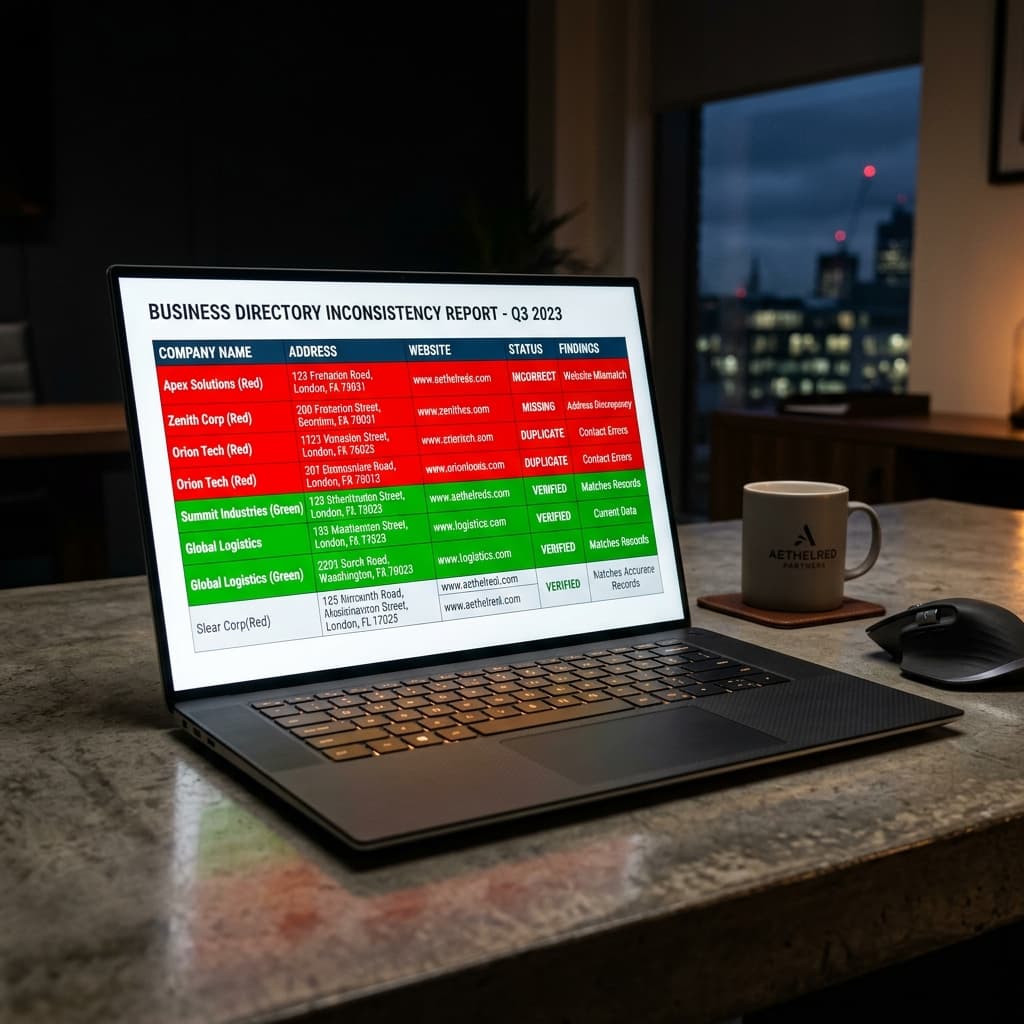
For platforms that cannot be updated programmatically, elite citation agencies maintain direct relationships with editorial teams at major directories, enabling faster manual corrections. They also execute aggressive suppression campaigns against duplicate listings—phantom versions of your business entity that have been auto-generated by aggregators pulling from conflicting data sources. Duplicate listings are particularly dangerous because the algorithm treats each as a separate, competing entity. When you have three versions of your company listed in the same city with slightly different addresses, the algorithm routes authority away from all three rather than consolidating it into one dominant entity.
Citation Building: The Offensive Phase
Once the existing citation landscape has been audited and remediated, the next strategic phase is aggressive citation building—systematically placing your Master NAP Record on high-authority platforms where your firm is not yet listed. For a commercial contractor in California, this means methodically targeting every major construction industry database, every regional business association, every government contractor registry, and every institutional procurement platform that maintains public vendor records.
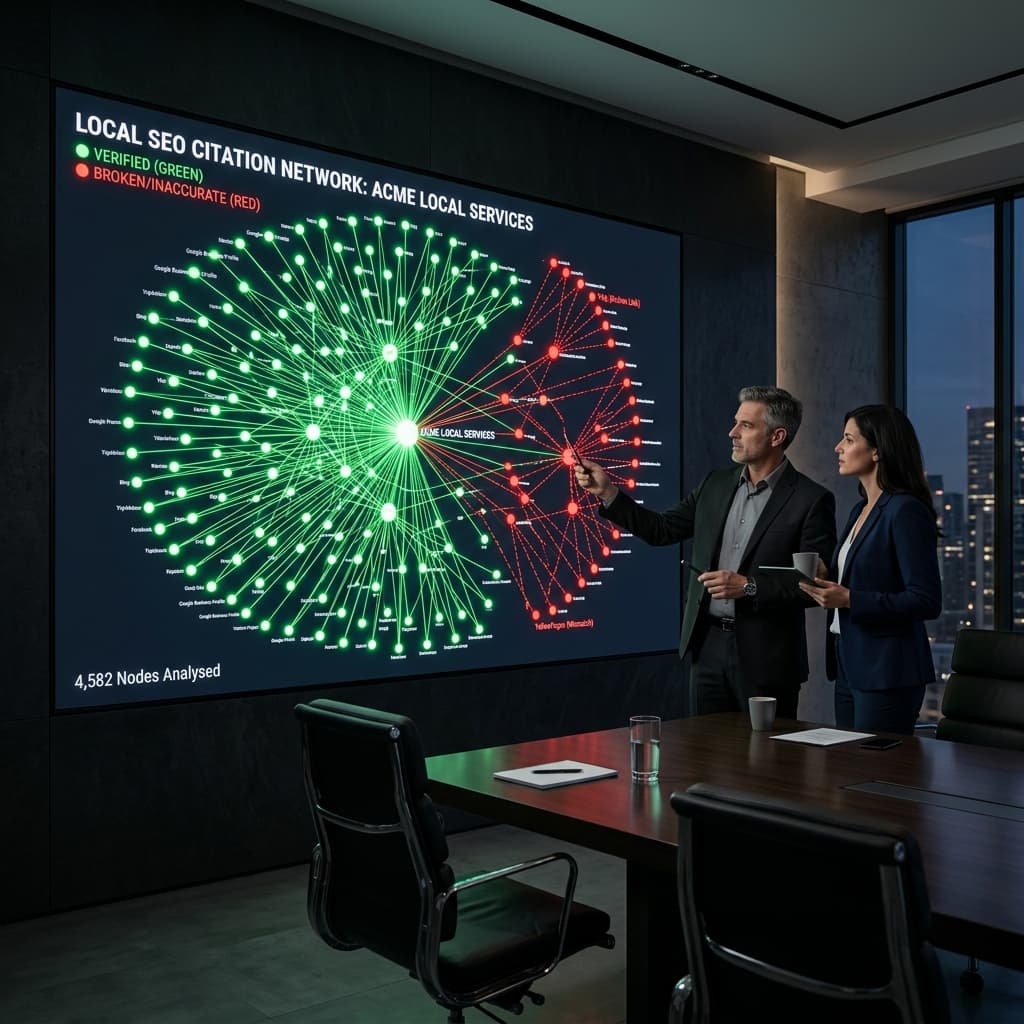
Each new citation placement on a high-authority platform functions as an additional verification signal, progressively reinforcing your algorithmic trust score. When the Google algorithm detects that your corporate identity appears consistently and authoritatively across 300 separate data points rather than 80, the mathematical probability of your entity receiving preferential treatment in high-value local searches increases proportionally. This is not a one-time activity; it is an ongoing intelligence operation requiring continuous monitoring, quarterly audits, and proactive placement campaigns to maintain the integrity of your digital corporate identity as your business evolves.
The Competitive Calculus
The contractors consistently dominating the Local 3-Pack in your territory are not necessarily the largest firms or the most heavily capitalized enterprises. In many markets, the top local search position is held by firms that have systematically engineered their citation profile with the same rigor they apply to their project management systems. They treat their digital corporate identity as an asset that requires active maintenance, not a static registration that once established can be permanently ignored.
Your competitors are outranking you not because their work is superior or their reputation is more credible. They are outranking you because their NAP data is mathematically cleaner. Because they submitted corrections to the four major aggregators last quarter. Because they suppressed their duplicate listings before the aggregator propagated the corrupted data further. Because they placed fifty new high-authority construction industry citations in January while your firm continued to be referenced under a phone number that has not been active since 2021. Every one of these individual decisions compounds over time into an insurmountable algorithmic authority gap.
Closing that gap requires the same mentality that elite contractors bring to a complex infrastructure project: systematic assessment, precise execution, rigorous quality control, and relentless follow-through. There is no shortcut. There is no hack. There is only the disciplined, methodical deployment of institutional-grade citation intelligence—executed at the speed and scale required to out-maneuver competitors running the same playbook. The firms that understand this create a permanent, self-reinforcing competitive moat. The firms that ignore it surrender territory every single quarter.

Audit Your Citations. Reclaim Your Territory.
Lemonade Ideas executes institutional-grade local citation audits for elite commercial contractors. We identify every inconsistency, suppress every duplicate, and build a mathematically dominant digital identity that forces the algorithm to rank your firm above inferior competitors on every high-value local search.
Deploy Citation Dominance