Let's brutally honest: 80% of your inbound leads are dying a slow, agonizing death in a voicemail box that will never be checked. You spend thousands of dollars on Google Local Services Ads, SEO, and paid media to get a homeowner to call you for a $20,000 roof replacement. Your receptionist misses the call because she's dealing with a screaming supplier. Two hours later, you call the lead back. Radio silence. Why? Because while you were leaving a three-minute voicemail, a hungrier competitor texted that same homeowner and booked the inspection. In the ruthless arena of modern home services, if you are not leveraging SMS marketing and automated text dispatching, you are fundamentally choosing to burn cash and forfeit massive market share to the competition.

The Devastating Mathematics of Ignoring SMS Communication
I see it every single week. Highly skilled HVAC companies, elite residential remodelers, and master plumbers looking at their P&L statements and wondering why their customer acquisition cost (CAC) is absolutely skyrocketing. They blame Google. They blame the economy. They blame the new generation of homeowners. But the reality is far more localized and entirely operational: Their "speed to lead" is archaic, and their follow-up mechanism relies entirely on behavioral patterns that died a decade ago.
When a pipe bursts and floods a kitchen at 7:00 AM, that homeowner is actively panicking. They jump on their smartphone, search for an emergency plumber, and dial the first three numbers they see. If your dispatcher doesn't answer instantly, you lose. But more critically, what happens to the leads generated from landing page contact forms? What happens to the inquiries that come in at 9:00 PM when the office is closed?
If your default organizational process is to have the office manager send a beautifully crafted, highly professional email the next morning at 9:15 AM, you have already lost the job. The data on this is not just compelling; it is violently decisive. Consider these brutal statistics that should keep every ambitious contractor awake at night:
- The 90% Read Rate: Approximately 90% of all SMS text messages are read within exactly three minutes of delivery. Conversely, the average open rate for a commercial email in the home services sector hovers dangerously around 18%, and that usually happens hours after it was sent.
- Response Velocity: A staggering 77% of SMS messages receive a direct response within 10 minutes. This is literally triple the engagement velocity of an email. When you need to book an estimate right now, SMS is the only viable weapon.
- The Omni-Channel Lift: By integrating automated SMS follow-ups into an existing CRM infrastructure alongside email pipelines, home service businesses systematically witness a terrifying 47.7% lift in total customer engagement.
The "Email First" Operational Failure
Cease immediately treating SMS as an afterthought. It is not a secondary channel; it is the primary artery of modern consumer transaction. If your entire sales pipeline hinges on a homeowner logging into Gmail, navigating past 40 promotional emails from Amazon, finding your message, reading it, and formally replying—you are deploying a strategy engineered for 2012. You are asking a frustrated homeowner with a leaking roof to perform administrative labor. Stop doing that. A text message bypasses the algorithmic noise, bypasses the spam folder, and lands directly on their lock screen.
4 Ruthlessly Effective SMS Strategies for $10M+ Operations
Understanding that SMS is powerful is entirely useless without a systematic framework for deployment. You cannot just blindly text your past 5,000 customers "Hey, need a new HVAC unit?" That is called spam, it will generate zero revenue, and it will aggressively get your corporate phone numbers flagged and blocked by mobile carriers via aggressive TCPA (Telephone Consumer Protection Act) violations.
To dominate your local market, you must utilize SMS marketing for contractors with tactical, surgical precision. Below are the exact four architectures that elite contracting empires use to squeeze every single dollar of ROI out of their lead generation efforts.

1. The "Speed to Lead" Auto-Responder (The Bleeding Edge)
When a prospect fills out a pricing request form on your website organically or through a Google Local Service Ad, your CRM must be structurally wired to instantly execute an automated text payload within exactly 60 seconds. We are not talking about 5 minutes; we are talking about 60 seconds.
The Script: "Hi [Name], this is Mike, the owner of Apex Roofing. I just received your request about a roof inspection. I'm on a job site now, but my dispatcher Sarah is ready to get you on the schedule for tomorrow. Can she give you a quick 2-minute call right now to lock in a time?"
Why does this destroy the competition? It feels intensely human. It establishes authority (from the owner). It sets a clear operational expectation (Sarah is going to call). And most importantly, it stops the homeowner from returning to Google to fill out another form with your competitor because you have already aggressively claimed their attention.
2. Precision Appointment Reminders (Killing the No-Show)
In extreme weather events or during peak seasons, your estimators are expensive, highly-trained assets driving $80,000 branded trucks across town. Every single time a homeowner "forgets" an appointment and isn't home, you are actively burning gross margin. An estimator sitting idle in a driveway is catastrophic to your P&L.
Your SMS infrastructure must automatically send a confirmation request 24 hours prior to the estimate, forcing a behavioral commitment.
The Script: "Hi [Name]. Your kitchen remodel estimate with David from Elite Builders is confirmed for tomorrow at 2:00 PM. Please reply YES to confirm or RESCHEDULE if something came up."
This is basic operational hygiene, yet 80% of local contractors fail to implement it because they are too cheap to invest $150 a month in a CRM text-messaging tier. Do not step on a dollar to pick up a dime. Limit friction.
3. The Relentless Google Review Engine
Home services marketing is a brutal war of attrition fought on the battlefield of Google Business Profiles. If you have 45 reviews and your direct competitor has 350 reviews, you are losing 40% of the market share implicitly, purely based on psychological social proof. The absolute most efficient method for vacuuming up 5-star Google Reviews at scale is an automated SMS post-job sequence.
Emails asking for a review are ignored. Pamphlets handed by the technician are thrown in the trash. But a text message sent exactly two hours after the project is completed, when the dopamine of a beautifully finished bathroom or a perfectly cooled house is peaking, is the ultimate leverage.
The Script: "Hey [Name], it was an absolute pleasure installing your new AC unit today. I'm running a competition with my crew this month. If you have 60 seconds to drop a quick 5-star review on our Google page, it helps us tremendously: [Link]. Thank you!"
4. The "Off-Season" Revival Protocol
Do you have a database of 3,000 past customers sitting in an archaic spreadsheet doing nothing? That is a goldmine waiting for an ignition spark. SMS marketing for contractors allows for highly targeted, seasonal reactivation campaigns.
In late September, HVAC companies must deploy a meticulously timed text blast to their entire historic install list.
The Script: "Hi [Name], winter is approaching fast. As a previous customer, we're giving you priority scheduling for our $99 Furnace Tune-Up before the first freeze hits. Reply TUNEUP to grab one of our 15 remaining spots this week."
This strategy alone can instantly generate $25,000 in immediate cash flow during a visually slow shoulder season, keeping your crews busy and your cash reserves high.
The Critical Legal Landscape: Navigating the TCPA Minefield
Listen very closely: SMS marketing is not the Wild West. You cannot simply scrape phone numbers from Zillow, buy a database off some shady third-party data broker, and start blasting your plumbing specials. The federal government takes this with profound seriousness. Under the TCPA (Telephone Consumer Protection Act), violations for unsolicited text messaging can result in massive, catastrophic fines ranging from $500 to $1,500 per single text.
If you arrogantly blast a non-compliant promotional text to a list of 10,000 people, you are functionally exposing your company to a $5,000,000 to $15,000,000 class-action lawsuit. This is not fear-mongering; it is a brutal legal reality.
To dominate SMS without exposing your contracting empire to risk, you must adopt an unshakeable adherence to these three foundational principles:
- Explicit Written Consent is Mandatory: A homeowner simply calling you to ask a question does NOT give you consent to market to them via SMS. The consent must be explicit and opt-in driven. If you use a contact form on your website for lead generation, you must include unchecked check-boxes that explicitly state: "By checking this box, you agree to receive automated promotional SMS messages from Apex Builders at the phone number provided. Consent is not a condition of purchase. Reply STOP to cancel." Do not try to be sneaky. Be legally robust.
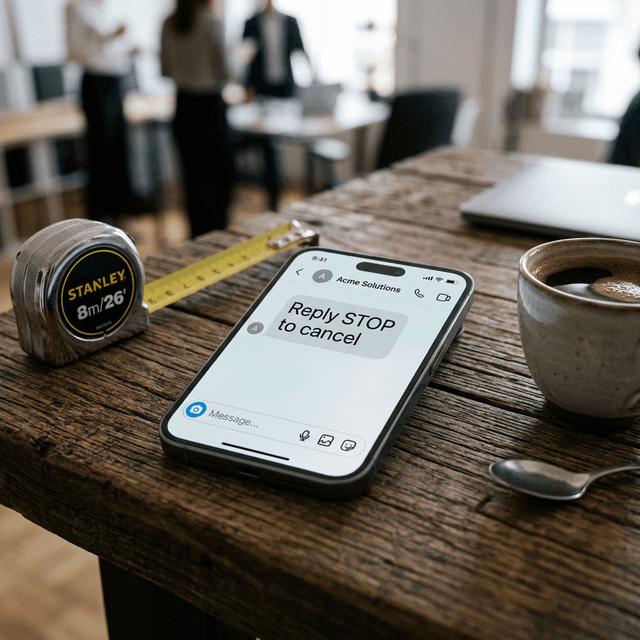
- The Sacred STOP Command: Every single promotional text message you ever originate must include an immediate optical out. The CTIA mandates that carriers structurally recognize keywords like STOP, END, CANCEL, and QUIT. If your system does not automatically purge those users from the sending queue the micro-second they reply, you are in direct violation.
- Honor the Quiet Hours: You are strictly forbidden by federal regulation from deploying promotional text campaigns outside of the 8:00 AM to 9:00 PM window in the recipient's exact time zone. Sending a burst marketing text at 4:30 AM is not just annoying; it is an active legal liability. Any competent CRM you deploy will automatically safeguard these time gates.
Engineering the Infrastructure: Selecting the Ultimate SMS Warfare Stack
The technological backbone you choose to deploy your SMS campaigns will dictate 90% of your success. If you are a small operator using an iPhone and manually copy-pasting numbers into a group text, you are operating as an amateur. To scale beyond $5M in gross revenue, your SMS layer must be inherently integrated with your CRM (Customer Relationship Management) software.
A fragmented ecosystem where your lead data lives in HubSpot or ServiceTitan, but your texting happens through a disjointed application like Google Voice, creates monstrous data silos. Your dispatchers will lose critical context, and important conversations will vanish entirely into the ether.
The 160-Character Limit is a Weapon, Not a Cage
Standard SMS structurally maxes out at exactly 160 characters. Do not view this as a frustrating limitation requiring grammar gymnastics. This physical constraint forces clarity, brevity, and overwhelming actionability. It physically prevents your marketing manager from attempting to squeeze four paragraphs of boring company history into a message. Every single character must fight for its life. State the value. Provide the link. Establish the CTA. Terminate the message.
When auditing platforms (like GoHighLevel, Jobber, ServiceTitan, or specialized engines like CallLoop), demand a system that operates seamlessly across the API tier. You require a system that features two-way conversational texting. When a client inevitably responds to an automated blast with a specific question (e.g., "Does the $99 tune-up include a filter replacement?"), that message must immediately populate on a unified dashboard in your office, allowing your dispatcher to instantly switch to a manual, conversational override and secure the closing.
Furthermore, demand elite analytics. You must track Delivery Rates, Click-Through Rates (CTR), and Unsubscribe velocity. If an SMS campaign blasting a "Spring Deck Discount" generates a catastrophic 4% unsubscribe rate, you immediately halt the campaign. Data tells the absolute truth. You are not guessing; you are analyzing an aggregated statistical feedback loop to refine the offering.
Final Protocol: The Transition Phase

Implementing a hyper-aggressive, legally compliant, architecturally sound SMS marketing program is not a secondary objective for Q4; it is an immediate organizational imperative. If you are actively ignoring SMS, you are actively choosing to let highly motivated leads slip through the digital cracks. You are granting your competitors a massive, structural advantage in speed and efficiency.
Stop placing the burden of communication onto the homeowner. Your job is to make the friction between the initial spark of inquiry and the physical arrival of your branded truck to be precisely zero. SMS eliminates the friction. It demands attention. It converts.
Assemble your lists cleanly. Acquire explicit consent meticulously. Craft offers that are violently compelling within 160 characters. Automate the initial response, but retain the human capability to override and close. The contracting firms that dominate the next decade will not simply build better houses; they will build unassailable, blazing-fast communication architectures.

Construct an Omnipresent Digital Foundation
Are you hemorrhaging incredibly expensive leads because your follow-up speed is fundamentally broken? Lemonade Ideas architects absolute digital dominance for elite construction and home service empires. We build the automated infrastructures, the high-conversion landers, and the SMS integrations required to utterly crush the competition.
Audit My Communication Tech Stack