Your business development rep made 47 cold calls today. Three people answered. Two said "not interested" before hanging up. One asked you to send an email that will rot in their spam folder forever. Meanwhile, a commercial property developer in your market typed "best general contractor for tenant improvement in Orange County" into Google at 10:14 AM, clicked on your competitor's blog article about tenant improvement timelines, downloaded their project planning guide, and scheduled a consultation—all before lunch. That developer never received a cold call. They were never interrupted during dinner. They found the contractor they needed through content that answered their exact question at the exact moment they were asking it. That is inbound marketing for commercial contractors, and it is systematically replacing outbound prospecting as the dominant pipeline engine for 8-figure construction firms.

The Death of Outbound: Why Cold Prospecting Is Mathematically Bankrupt
The construction industry clings to outbound prospecting like a drowning man gripping a piece of driftwood. Cold calls, golf course handshakes, association luncheons, trade show badge scans—these were the pipeline mechanisms of the 1990s. They worked because commercial decision-makers had no alternative information source. If a property developer wanted to evaluate a general contractor, they either had to take a referral from someone they trusted or wait for your salesperson to show up with a capabilities brochure. That information asymmetry was your leverage. And the internet obliterated it permanently.
Today, 72% of commercial construction decision-makers complete their vendor research online before ever contacting a single contractor. They've already compared portfolios. They've already read case studies. They've already checked your Google reviews, your bonding capacity disclosures, your safety record, and your project history. By the time they pick up the phone, they've already made a shortlist—and if you weren't visible in their online research process, you are not on that list. No amount of cold calling will put you there. You are competing against contractors who showed up at the exact moment the developer had a question, provided an authoritative answer through content, and established credibility before the first conversation ever occurred. That is the irreversible structural advantage of inbound marketing for commercial contractors.
The math makes the obituary even more definitive. The average commercial construction BD rep costs your firm $85,000 to $140,000 annually in fully loaded compensation—salary, benefits, vehicle allowance, CRM software, trade show attendance, entertainment budget. That rep generates, at peak performance, 80 to 120 qualified conversations per year, of which 15 to 25 will progress to a proposal. Your cost-per-qualified-opportunity through outbound is somewhere between $3,400 and $9,300. An equivalent inbound marketing investment of $6,000 to $12,000 per month in content creation, SEO optimization, and conversion infrastructure generates 200 to 500+ organic website visitors per month from commercial-intent search queries, of which 4% to 8% convert into form submissions. That's 8 to 40 qualified inquiries per month, every month, at a cost-per-lead between $150 and $1,500. The inbound channel doesn't take vacation. It doesn't get rejected at the front desk. It doesn't spend $400 on a golf outing that produces zero pipeline. It works at 3 AM on Sunday while your BD rep is asleep.
The Outbound Extinction Event
The average cold call connection rate in B2B construction has plummeted from 14% in 2010 to 2.3% in 2026. For every 100 calls your BD rep makes, they will speak to 2.3 human beings. Of those, statistically zero will convert to a signed contract from that single interaction. You are paying a six-figure salary for someone to leave voicemails that are deleted within 4 seconds. Meanwhile, the blog article you published 18 months ago about "5 Critical Mistakes in Commercial Tenant Improvement Planning" continues to rank on page one of Google and delivers 3 qualified inquiries per month—perpetually, compoundingly, and for zero marginal cost.

The Content Engine: What Commercial Decision-Makers Actually Search For
The foundation of inbound marketing for commercial contractors is content that intercepts decision-makers at the exact moment they are formulating a buying decision. This isn't corporate blog fluff about "the importance of choosing the right contractor." That kind of vapid, generic content attracts no one because it answers no specific question. Effective inbound content is surgically targeted at the precise, high-commercial-intent questions that property developers, institutional REITs, facility managers, and architectural firms are typing into Google every single day.
These questions fall into three distinct categories, each requiring a different content format and conversion strategy. Problem-Aware queries come from decision-makers who know they have a construction need but haven't yet started evaluating vendors. They search phrases like "how long does a commercial tenant improvement take in California," "prevailing wage requirements for public school renovation," or "cost per square foot for ground-up commercial construction 2026." These queries represent the top of your inbound funnel—prospects who are educating themselves. The content that captures them must be genuinely educational: comprehensive guides, data-driven cost breakdowns, regulatory explainers, and timeline frameworks based on your actual project experience. No sales pitch. No "call us today." Just an authoritative answer that positions your firm as the entity that understands their problem deeply enough to explain it clearly.
Solution-Aware queries come from prospects who have progressed past education and are now actively seeking a contractor. They search "best commercial general contractor in Los Angeles for office build-out," "design-build contractor Orange County tenant improvement," or "LEED certified contractor Southern California." These require portfolio-centric landing pages, case studies with specific project data (square footage, budget, timeline, challenges overcome), and comparison guides that differentiate your firm's specific capabilities from the generic market. The content must answer the implicit question: "Why should I choose you over the 37 other contractors who claim to do exactly what you do?"
Decision-Ready queries come from prospects at the very bottom of the funnel—they've selected a shortlist and are performing final due diligence before issuing an RFP or scheduling consultations. They search "[Your Company Name] reviews," "[Your Company Name] vs [Competitor Name]," or "[Your Company Name] bonding capacity." For these queries, you need a fortress of trust content: video testimonials, project walkthroughs, safety records, insurance documentation, and an immediately accessible consultation booking mechanism with zero friction. If a decision-ready prospect lands on your site and can't book a meeting in two clicks, you've lost them to the competitor who made it easy.
The Compounding Content Asset
A single, expertly crafted 2,500-word blog article targeting the query "commercial tenant improvement cost per square foot California" costs approximately $800 to $2,500 to produce. Once published and indexed by Google, it generates an average of 120 to 380 organic visits per month for 24 to 36 months. Over its lifespan, that single article delivers 2,880 to 13,680 targeted visits at a cost of $0.07 to $0.87 per visit. Compare that to Google Ads for the same keyword at $8.40 per click. The inbound article is 10x to 120x more cost-efficient, and unlike the ad, it never stops working when you stop paying.
The SEO Architecture: Engineering First-Page Dominance
Content without SEO architecture is a library with no address. You could write the most brilliant article ever published about commercial construction bidding strategy, but if Google's algorithm can't properly index, categorize, and rank it, it will sit on page 47 of search results—invisible to every prospect who would have found it invaluable. Inbound marketing for commercial contractors demands a meticulous technical SEO foundation that most construction companies either don't know exists or deliberately ignore because their "web guy" insisted that good content ranks itself. It doesn't. Not anymore. Not in 2026. Not with 85,000 other construction-related articles competing for the same 10 organic positions on page one.
The SEO architecture begins with keyword clustering—grouping semantically related search queries into content pillars that Google's algorithm recognizes as topical authority signals. Instead of writing one article about "commercial construction" and hoping it ranks for everything, you build interconnected content clusters. A pillar page on "Commercial Tenant Improvement Construction" links to supporting articles on "TI cost per square foot by industry," "TI construction timeline planning," "ADA compliance in tenant improvements," "choosing finishes for Class A office TI," and "landlord vs tenant construction responsibilities." Each supporting article links back to the pillar. Google's algorithm interprets this web of interconnected content as irrefutable evidence that your website is the definitive authority on tenant improvement construction. The result is that every article in the cluster ranks higher than it would in isolation, creating a compounding authority effect that accelerates with every new piece of content you publish.
Beyond content architecture, technical SEO performance is a non-negotiable ranking factor. Your website must load in under 2.5 seconds on mobile devices, implement proper schema markup (Article, LocalBusiness, FAQPage structured data), use semantic HTML headings (a single H1 per page with logical H2/H3 hierarchy), deploy internal linking with contextually relevant anchor text, and maintain a clean XML sitemap that Google's crawlers can process without errors. Construction companies running on bloated WordPress templates with 47 plugins, 8-second load times, and stock photography from 2018 are structurally incapable of competing in organic search against firms running lightweight, performance-optimized Next.js architectures. The technology stack isn't a vanity choice—it's a ranking weapon.
The Conversion Infrastructure: Turning Readers Into Revenue
Driving 500 organic visitors per month to your construction blog is meaningless if those visitors read your article, nod approvingly, and then close the tab without ever identifying themselves. Traffic without conversion infrastructure is vanity, not strategy. Inbound marketing for commercial contractors requires a systematic conversion architecture layered throughout every piece of content, designed to capture prospect information at multiple engagement levels without disrupting the reading experience that earned their attention in the first place.
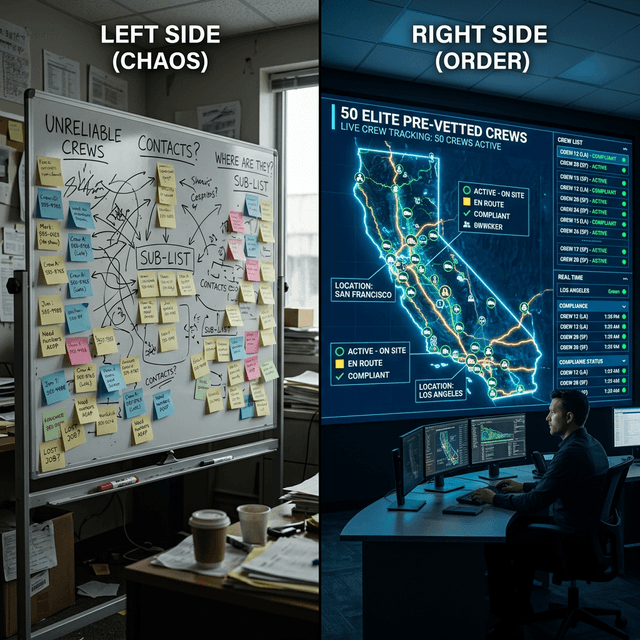
Outbound Model
BD rep makes 47 cold calls → 3 answers → 0 meetings booked → Spends $400 at networking dinner → Gets 2 business cards → Follows up 3x → Both go cold → Repeats daily for $120K/year → Pipeline depends entirely on one person's daily energy and persistence.
Inbound Model
Publish 4 authority articles/month → Google indexes and ranks them → 500+ commercial-intent visitors/month find you → 20-40 download content upgrades → 8-15 book consultations → Automated nurture converts 3-5 into proposals → Pipeline compounds monthly → Works 24/7/365 without human intervention.

The 12-Month Inbound Flywheel: From Zero to Dominant
Inbound marketing for commercial contractors is not an overnight transformation. It's a flywheel that requires 90 to 180 days of sustained investment before the compounding effects begin producing measurable pipeline results. The firms that fail at inbound are invariably the ones who publish six articles in month one, see no immediate leads, panic, and revert to cold calling. They fundamentally misunderstand the asset they're building. Every article is a permanent infrastructure investment that generates returns for years—not a campaign with a start and end date.
Months 1-3: Foundation. Conduct comprehensive keyword research to identify 50-100 commercial-intent search queries in your market. Build a content calendar prioritizing queries by search volume, commercial intent, and competitive difficulty. Publish 3-4 articles per month minimum, each exceeding 2,500 words with original photography, data tables, and actionable frameworks. Implement full technical SEO: schema markup, XML sitemap, internal linking architecture, page speed optimization, and Google Search Console configuration. During this phase, you will see minimal organic traffic and zero inbound leads. This is normal. You are laying pipe, not harvesting crops.
Months 4-6: Traction. Google begins recognizing your domain as a topical authority. Articles published in months 1-2 start climbing from page 4-5 to page 2-3 of search results. Organic traffic increases 150-300%. You begin receiving 3-8 inbound inquiries per month from content readers, primarily from long-tail keywords with lower competition. Your content library now contains 12-18 articles that form the nucleus of your authority positioning. This is the phase where most firms either commit fully or abandon the strategy—and the ones who commit are the ones who dominate 12 months later.
Months 7-12: Compounding. Multiple articles reach page one of Google. Cross-linking between pillar pages and supporting content creates an algorithmic flywheel where new articles rank faster because your domain authority has compounded. Organic traffic exceeds 500-1,500 monthly visitors. Inbound inquiries stabilize at 15-40 per month. Cost-per-lead drops below $200. Your blog content begins getting shared by industry publications, architects, and property management firms—earning backlinks that further accelerate your rankings. At this stage, your inbound marketing engine generates more qualified pipeline than your entire outbound operation, at a fraction of the cost, with zero dependency on individual personnel.
The Lemonade Standard: Inbound Pipeline Architecture for Commercial Contractors
At Lemonade Ideas, we don't write blog posts for construction companies. We architect comprehensive inbound pipeline systems engineered to position commercial contractors as the definitive authority in their market, attract decision-makers through content that answers their most critical questions, and convert that attention into a perpetually compounding stream of qualified commercial opportunities. Every article we produce is a strategic infrastructure asset—keyword-researched, SEO-optimized, conversion-engineered, and built on Next.js headless architecture for absolute performance dominance.
Our clients don't chase leads. Leads find them. They wake up to consultation requests from property developers who read their article at 11 PM the night before. They receive RFP invitations from institutional firms who found their case study through organic search. They close $5M+ contracts with prospects who never received a single cold call—because the content pipeline did the entire job of education, qualification, and persuasion before the first handshake ever occurred.
- Strategic Content Architecture: Pillar-and-cluster content ecosystems targeting 50-100 commercial-intent keywords, engineered to establish algorithmic topical authority that compounds with every published article.
- Technical SEO Infrastructure: Schema markup, XML sitemaps, internal linking architecture, sub-2-second page loads, and Google Search Console optimization deployed on performance-first Next.js infrastructure.
- Multi-Layer Conversion Engineering: Content upgrades, inline case studies, consultation offers, and automated nurture sequences systematically converting anonymous readers into identified prospects and signed contracts.
- Authority-First Content: 2,500+ word expert-level articles with original photography, data-driven insights, and zero corporate fluff—content that commercial decision-makers actually share, bookmark, and return to.
- Complete Pipeline Attribution: End-to-end tracking from organic search impression to consultation booking to signed contract, providing forensic visibility into which content assets generate which revenue outcomes.
The commercial contractors who will own their markets in 2026 and beyond are not the ones with the biggest BD teams, the most aggressive cold callers, or the largest trade show booths. They are the ones who built an inbound infrastructure so comprehensive, so authoritative, and so deeply embedded in Google's organic architecture that prospects find them effortlessly—and competitors find them impossible to displace. Stop renting attention through cold calls and paid ads. Start building the content infrastructure that attracts it permanently. The leads are already searching for you. The only question is whether they'll find you—or the contractor who decided to build the inbound engine first.

Build Your Inbound Pipeline
Stop paying six-figure salaries for cold callers who leave voicemails into the void. Lemonade Ideas engineers comprehensive inbound marketing systems for commercial contractors that attract, educate, and convert decision-makers through authority content that works 24/7/365.
Deploy Inbound Infrastructure