There is a pathetic, deeply entrenched myth in the commercial construction industry that whoever comes in at the absolute bottom of the bidding table automatically takes home the contract. If you are operating a multi-million dollar general contracting firm and your sole sales strategy is to butcher your own profit margins just to win the bid, you are not running a business; you are running a charity for wealthy real estate developers. High-ticket construction closing is an apex psychological discipline. It is about utterly dominating the initial B2B conversation, aggressively controlling the architectural narrative, and forcing the developer to view you not as a disposable commodity, but as an indispensable risk-mitigation partner. This technical breakdown destroys the "lowest bidder takes all" fallacy and details exactly how elite 8-figure builders leverage digital authority and structural sales psychology to close premium commercial contracts while maintaining aggressive profitability.

The Absolute Reality of the Commercial Bidding War
Let's establish a foundational truth: Developers and REIT managers are exceptionally intelligent with their capital. They are professional risk assessors. When they release the plans for a massive new medical plaza or a luxury hyper-scale logistics center, they will inherently seek three bids.
If your bid comes in at $14.2 million, and a competitor comes in at $13.5 million, the amateur contractor instantly panics. They begin stripping quality engineering out of the proposal, hacking away at premium materials, and begging their subcontractors for brutal discounts in a desperate scramble to match the $13.5M floor.
This is a race to the bottom, and the winner gets the distinct privilege of executing a massive project with razor-thin margins and massive liability risk. Elite contractors do not play this game. They look at the $14.2 million figure, and instead of lowering the price, they massively elevate the perceived value.
The Price-Discounting Death Spiral
When you discount your price without changing the scope of work, you are explicitly communicating two devastating things to the client: First, that your original price was artificially inflated padding designed to gauge them. Second, that your company lacks the backbone to stand firmly behind the mathematical reality of its own estimating team. A developer respects a firm "No" far more than a desperate, spineless 10% discount.
Phase 1: Pre-Framing the Value Proposition
High-ticket B2B closing does not begin in the boardroom; it begins six months prior when the developer begins researching your digital footprint. Before they ever allow you to submit a bid, they are auditing your authority.

- The Digital Moat. If your website looks like it was built in 2012 by an intern—if it lacks immense, high-resolution project folios, capability statements, and structural engineering case studies—you have immediately lost the pricing war before you even open your mouth. A premium $14M bid requires a $100M digital aesthetic. They must feel they are hiring an institution, not a guy with a truck.
- Pre-Emptive Objection Handling. The developer's primary fear is not the cost of the project; it is the cost of absolute failure. Delays, change orders, and permitting nightmares burn their capital fiercely. Your entire marketing funnel must obsessively highlight your flawless logistics, your rigorous pre-construction planning, and your ironclad timelines.
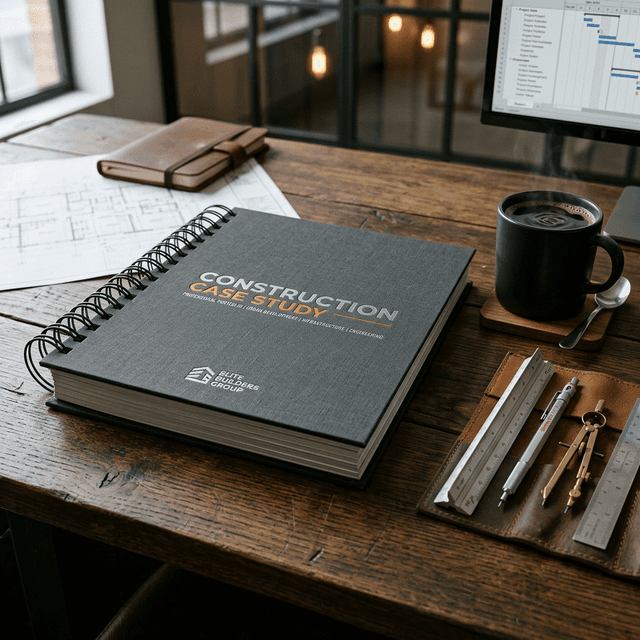
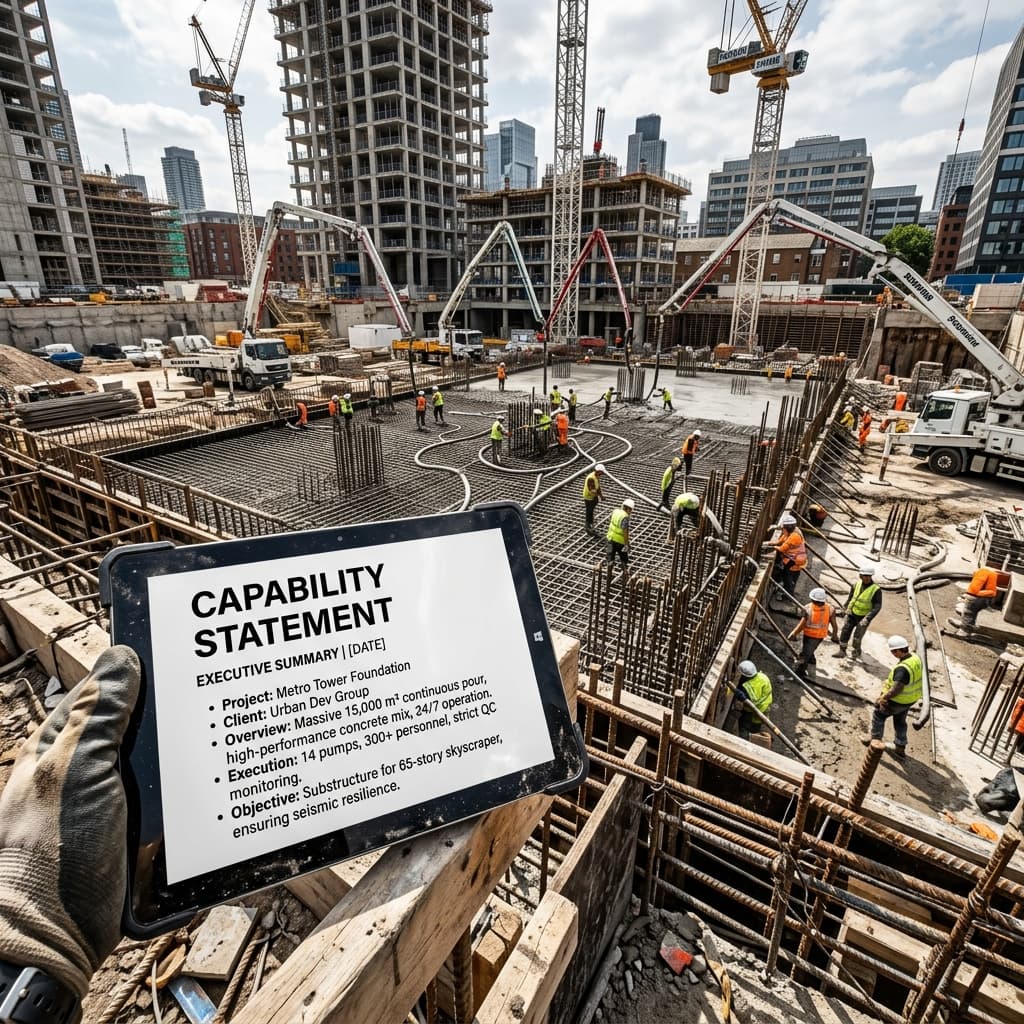
- The Capability Statement Brief. Elite firms do not send "brochures." They dispatch highly optimized, data-dense digital Capability Statements. We are talking about severe, quantifiable metrics: "Our firm executes structures with a median variance of 1.4% from original architectural estimations." Hard data commands high premiums.
Phase 2: Dominating the Bidding Presentation
When it is time to present the bid, you are not there to hand them a spreadsheet and softly apologize for the steel prices. You are there to commandeer the narrative. You must shift the entire conversation violently away from "line-item costs" and directly into "long-term asset yield."
Every single slide, every spoken sentence must dictate inevitable success. If the competitor is $700,000 cheaper, you must aggressively explain *why* that missing capital represents a catastrophic risk to the developer's timeline.

You look the investor directly in the eye and you utilize the Cost-of-Delay Framework:
"Mr. Davis, our bid is $14.2 million. We note that you likely received a significantly lower comparative bid. Here is the unvarnished reality: The cheaper bid relies on Tier-3 mechanical subcontractors and a reactive, non-guaranteed supply chain. When their HVAC timeline slips by 6 weeks—and historical regional data proves it will—what is your daily holding cost on this facility? What is the penalty for missing your Q3 operational launch? Our $700,000 premium is not markup. That is the exact mathematical cost of our massive predictive logistics engine. We are the only firm in this room actively guaranteeing an August 1st delivery. Period."
You are selling certainty. Certainty in commercial construction is the most expensive, highly sought-after commodity on the planet. Wealthy developers will happily pay an 8% premium if it buys them a flawless, stress-free night of sleep while their millions are tied up in the dirt.
Phase 3: The Psychology of Leverage & Walk-Away Power
The most intoxicating force in a B2B negotiation is absolute indifference to the outcome. When a contractor smells desperate, the developer's procurement team will ruthlessly rip the firm apart line item by line item, forcing concessions on material grade and labor hours until the project is a guaranteed loss.
How do you manufacture walk-away power? You manufacture it by having an aggressively full, highly-optimized sales pipeline fueled by ruthless digital marketing.
- The Organic Pipeline: When your SEO architecture ranks your firm #1 for "Commercial Logistics Builders CA," you are fielding inbound leads daily. You do not *need* any single specific contract to survive.
- The Take-Away Move: When the developer demands an absurd, margin-crushing $400,000 cut, you stand up. You do not negotiate against yourself. You politely explain that your firm's operational integrity requires strict adherence to your estimating formulas, and that taking the project at that price guarantees a compromised outcome—a risk you refuse to force upon the client. You shake hands, and you walk towards the door.

Escaping the Commodity Trap
To reiterate: A general contractor selling time and materials is a fast-food worker selling a burger. It is a pure, unprotected commodity. There is always someone willing to flip the burger for fifty cents less. You can never win a permanent victory in the commodity trenches.
The Value Shift
You must stop selling concrete, steel, and manual labor. You must start selling accelerated logistics, mitigated financial exposure, absolute schedule adherence, and premium executive reporting. When a client understands that your firm’s infrastructure will proactively save them from a millions-of-dollars disaster halfway through the build phase, your higher initial bid ceases to be a cost; it miraculously transforms into highly lucrative insurance.
High-ticket closing is not a script. It is an ecosystem. It requires your website, your branding, your case studies, and your boardroom presence to operate in absolute, unapologetic unison. You are an elite, 8-figure enterprise constructing the skyline. The moment you believe you are worth the premium, the absolute market will aggressively validate you.

Arm Your Digital Infrastructure to Win
Are you losing multi-million dollar contracts to inferior builders solely because their digital presence manipulated the client into trusting them over your superior skillset? We build the uncompromising digital moats that allow commercial contractors to charge a massive premium and command total B2B respect. Stop negotiating from weakness.
Audit My Brand's Selling Power