Let's brutally honest about the high-stakes world of commercial contracting: Buying shared leads from third-party data brokers is a mathematically guaranteed race to the bottom of the gross margin barrel. If you receive an alert for a $4.5 million medical facility remodel, and you know instinctively that four other hungry general contractors in your zip code just received the exact same alert, you have already lost your leverage before the opening bid is even drafted. You are no longer an elite builder offering a bespoke solution; you have been instantly commoditized into a spreadsheet column, destined to be selected purely on who is willing to slash their profit margins the deepest. If you want to scale a commercial construction empire past the $10M, $20M, or $50M threshold, you must fundamentally reject the shared lead model and engineer a proprietary, unassailable inbound marketing engine that forces high-net-worth real estate developers to hunt you down directly.

The Crushing Mathematics of the "Shared Lead" Illusion
I sit across the table from commercial contractors every single month who are bleeding cash through a fundamental misunderstanding of their Customer Acquisition Cost (CAC) pipeline. They boast about their high-tier subscriptions to lead generation networks—Dodge Data, ConstructConnect, or generalized B2B brokerages—believing they are accessing a VIP list of commercial clients.
This is a fatal delusion. You are not accessing an exclusive pipeline; you are participating in a highly structured, predatory gladiatorial arena where the only prize is a compressed profit margin. Let's break down the devastating math behind commercial construction leads that are sold to multiple parties simultaneously.
Assume the average close rate on a shared commercial lead is hovering around 8%, which is generous considering the ruthless nature of open-bid commercial wars. If you buy 100 leads to land 8 jobs, you are inherently absorbing the administrative cost, the estimating hours, and the psychological fatigue of 92 absolute failures. But the damage is far worse when you analyze the 8 jobs you theoretically won. Because you were aggressively bidding against four other firms who received the exact same data payload, your estimators were forced to trim the fat, heavily discount the contingencies, and squeeze the net profit margin into the single digits just to secure the signature.
- The Value Deficit: When a property developer utilizes a brokerage site to find a contractor, they are signaling intent for commoditization, not partnership. They want the cheapest steel, the fastest pour, and the lowest friction. They do not care about your 30-year legacy or your elite safety record.
- The Estimator Burnout: Your highest-paid, most brilliant estimating talent is spending 60 hours a week crunching numbers on $8M tenant improvements that you statistically will never win. This is a massive hidden cost dragging down your P&L.
- The Erosion of Brand Authority: Elite commercial brands do not desperately chase the same public leads as the guy operating out of his basement with a rented skid steer. By participating in the shared market, you are actively diluting your perceived market authority.
Stop Letting Algorithms Dictate Your Revenue
When your entire pipeline relies absolutely on a third-party lead broker sending you an email notification, your business is functionally fragile. They control the lead volume, they control the pricing structure, and they control your access to the market. You do not own a marketing system; you are simply renting access to an overcrowded, miserable bidding war. The only viable path to 8-figure sustainability is total ownership of a proprietary inbound engine.
The Architecture of Proprietary Commercial Dominance
Owning your commercial construction leads means engineering a digital ecosystem where institutional investors, franchise owners, and commercial property developers discover your firm organically, vet your authority instantly through your digital footprint, and contact your office directly for a sole-source negotiation.
When a developer contacts you directly—without filtering through a broker site—you have infinitely more leverage. You dictate the pace, you protect the margin, and you operate as a consultant rather than a desperate bidder. Here are the three non-negotiable weapons required to build this proprietary machine.

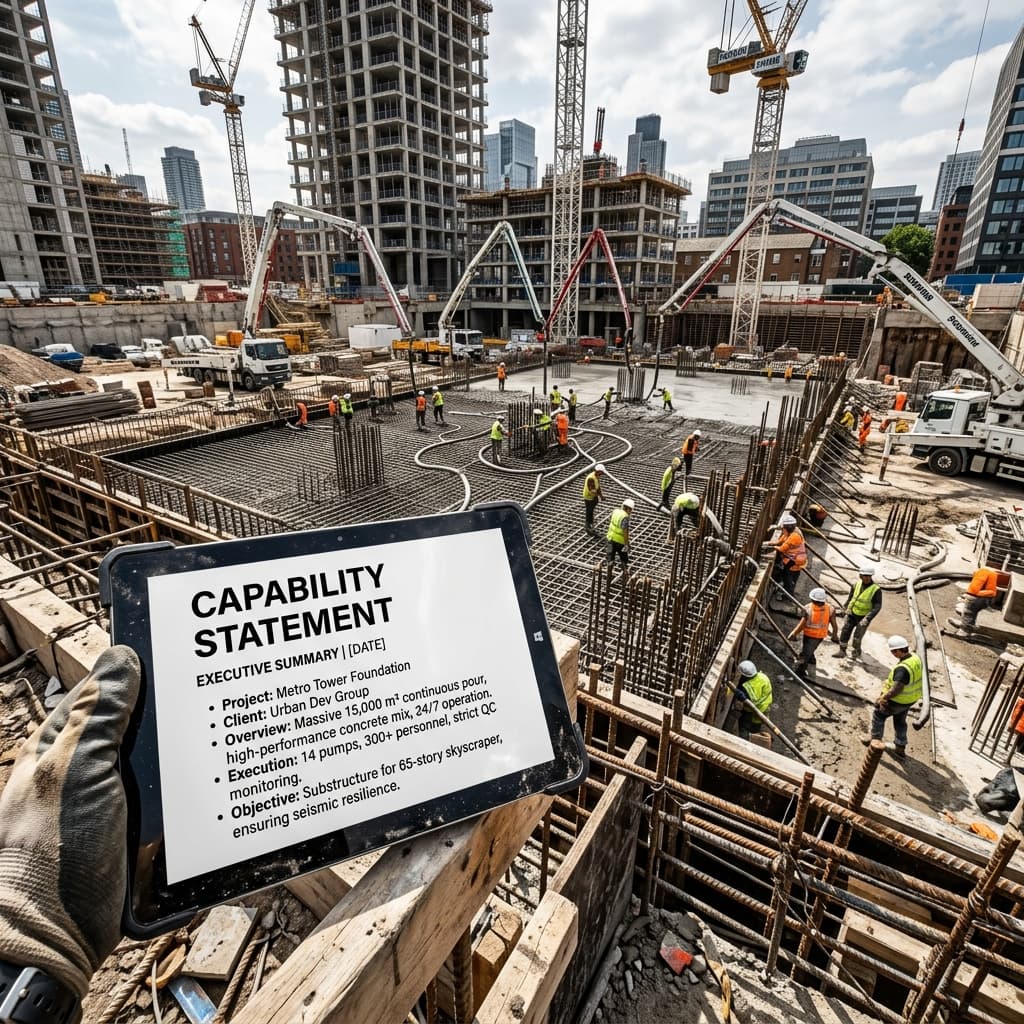
1. The "Trophy Case" Case Study Protocol (The Financial Narrative)
The most catastrophic mistake commercial contractors make on their websites is treating their portfolio like an Instagram feed. They upload 15 gorgeous pictures of a finished warehouse and write a useless two-sentence caption saying "We built this great warehouse in Dallas." This is utterly meaningless to a B2B decision-maker. Commercial developers do not buy beautiful buildings; they buy financial outcomes, risk mitigation, and timeline velocity.
To generate exclusive commercial construction leads, your case studies must transform into financial and operational war stories.
The Required Anatomy of a B2B Case Study:
- The Core Business Problem: "The client required a 50,000 sq ft logistics hub completed 30 days before the Q4 supply chain rush, battling massive material shortages."
- The Engineering Solution: Detail the specific, technical pivot your firm made (e.g., executing a pre-cast tilt-up method instead of traditional steel framing) to accelerate the schedule.
- The Financial ROI: This is the kill shot. "By delivering the facility 14 days ahead of schedule, we allowed the client to process an additional $2.1M in Q4 inventory before Black Friday."
When a property developer reads a case study documenting how you saved a peer $2.1M through sheer operational competence, they do not go request three other bids. They call your office immediately. That is a proprietary lead.
2. Hyper-Surgical B2B LinkedIn Ad Targeting
Stop wasting money on generalized Google Search Ads for broad terms like "commercial construction company," where you are paying $40 a click to argue with homeowners looking for a patio extension or college students researching architecture. The apex predator of acquiring commercial construction leads is LinkedIn B2B targeting.
LinkedIn allows you to violently laser-target the exact human beings who control multi-million dollar capital deployment budgets.

You do not run an ad saying "We build things." You deploy a highly produced video case study directly into the feeds of users who explicitly hold titles such as:
- Director of Facilities Expansion
- VP of Commercial Real Estate Development
- Director of Retail Operations (for franchise builds)
- Healthcare Infrastructure Manager
You restrict the geographic targeting to the exact metropolitan radius your crews operate in. You are no longer waiting for them to search for you; you are forcefully inserting your undeniable competence directly onto the screens of the specific individuals holding the $15M checks.
3. Hyper-Niche SEO (The Organic Moat)
Elite commercial contractors understand that ranking for broad, generic keywords is a vanity metric trap. Generating highly qualified commercial construction leads organically requires you to dominate the "long-tail" hyper-specific search queries that signify massive B2B intent.
A developer looking for a cheap fix searches "commercial contractor near me." An institutional real estate director burdened with aggressive OSHA requirements and a rigid timeline searches "OSHPD compliant medical facility contractor Los Angeles."
Your digital infrastructure must have dedicated, high-performance landing pages for every specific vertical you dominate. You need a dedicated page for "Ground-Up Retail Construction," a dedicated page for "Class A Office Tenant Improvements," and a dedicated page for "Industrial Warehouse Retrofitting." When your prospect searches for their highly specific problem, your website must appear as the singular, undisputed master of that specific domain. This creates an immediate cognitive moat that destroys your generalized competitors.
The Infrastructure: Why Your Website is Killing $5M Deals
You can deploy the most aggressive, mathematically perfect LinkedIn strategy in the world, but if that highly qualified VP of Development clicks your link and lands on a website built on a slow, archaic template from 2014, the deal is dead on arrival.
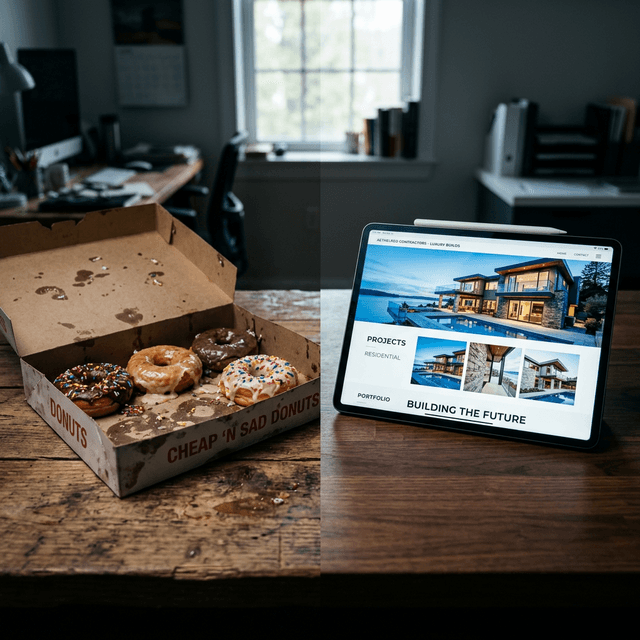
In high-stakes commercial construction, your digital aesthetic is a direct reflection of your operational competence. If your website takes 6 seconds to load, has broken mobile formatting, and looks like it hasn't been updated since the Obama administration, the subconscious message you are broadcasting to the developer is: "We are disorganized, we lack attention to detail, and we operate using legacy capabilities."
Performance equals Trust in B2B Markets
A high-net-worth developer is evaluating the risk of handing you millions of dollars. Your website must be brutally fast, aggressively modern, and architected like a Fortune 500 tech company. The perception of premium capability justifies premium pricing. If you look like a commodity, you will be paid like a commodity.
Your required digital foundation must include:
- Sub-Second Load Times: Eradicate bloated code. Velocity proves competence.
- High-Fidelity Videography: Embedding drone fly-throughs of active job sites to prove massive scale and organizational cleanliness.
- Immediate B2B Conversion Mechanisms: Not a generic "Contact Us" form, but a dedicated "Request a Project Audit" mechanism wired directly via API to your executive CRM.
The Final Closer: Escaping the Rat Race Forever

Continuing to buy shared commercial construction leads is a strategic surrender. It is an admission that you do not know how to market your own brand, and you are willing to let a third-party algorithm dictate your revenue ceiling and your profit margins.
The transition from a desperate bidder to a sought-after commercial authority requires an aggressive shift in capital deployment. You must stop paying lead brokers and start investing in your own unassailable digital moat. You must weaponize your past success through financial case studies, surgically target the decision-makers via LinkedIn, and dominate the organic search landscape for highly technical, high-intent B2B queries.
When the phone rings, and it is a hospital developer who has already spent 20 minutes reading your case studies on strict OSHPD compliance, you are no longer a vendor answering an RFP. You are a highly-paid consultant arriving to solve a multi-million dollar crisis. You control the bid. You protect the margin. You scale the empire.

Construct an Omnipresent Digital Foundation
Are you hemorrhaging gross margin battling other contractors for bottom-tier shared commercial construction leads? Lemonade Ideas architects absolute digital dominance for elite commercial construction empires. We build the proprietary B2B inbound engines, the hyper-aggressive LinkedIn funnels, and the high-ticket SEO required to make developers hunt you down directly.
Audit My B2B Lead Engine