You are a highly competent, aggressively scaled 8-figure commercial contractor operating out of California. Your project managers obsessively enforce OSHA safety regulations on the job site every single morning. Your structural engineers meticulously guarantee seismic code compliance in every multi-level parking structure you pour. You pay millions in insurance premiums to brutally protect your firm's hard-earned capital from catastrophic physical liabilities. Yet, right now, as you read this, your firm is leaving a massive, completely unguarded access point violently open for predatory "serial plaintiff" law firms to walk right in and legally force a $50,000 settlement out of you. This severe exposure is not on your physical job site. It is coded directly into the underlying, utterly broken architecture of your outdated corporate website. If your digital footprint is not engineered to strict ADA Title III (WCAG 2.1 AA) guidelines, you are basically handing an opportunistic attorney a blank check. Welcome to the terrifying underworld of digital compliance lawsuits.
The Brutal Mechanics of the Serial Plaintiff Extortion Machine
Most commercial construction owners are completely unaware of how ruthlessly algorithmic the threat of ADA (Americans with Disabilities Act) website lawsuits has become. They operate under a tragically naive assumption that "We are just a B2B builder, we don't sell shoes online, so why would a blind person sue our website?" That is not how the law works, and more terrifyingly, that is not how the predatory legal machine works.
Under extreme legal interpretations of Title III of the ADA (which guarantees equal access to "places of public accommodation"), federal judges have increasingly ruled that digital websites themselves are extensions of physical commercial spaces. Therefore, if a visually impaired user utilizing advanced "screen-reader" software cannot flawlessly navigate your poorly-coded portfolio of logistics centers, your firm is in direct violation of federal civil rights laws.

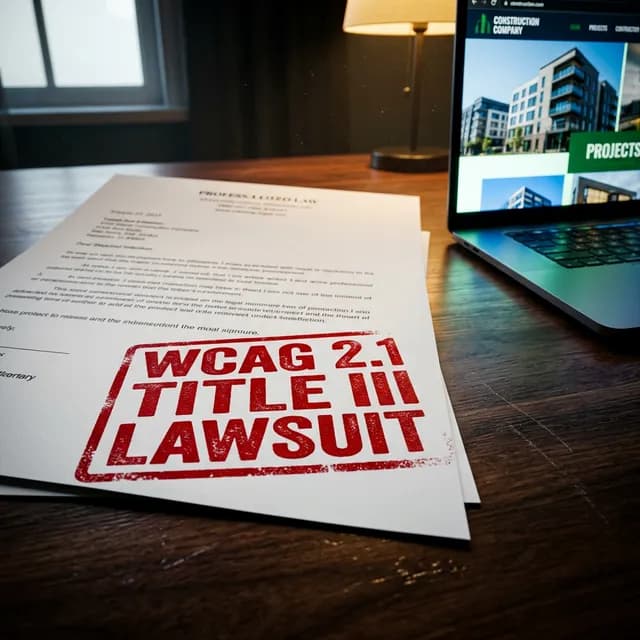
The nightmare scenario plays out like this: Small, aggressive law firms deploy automated scraping "bot" networks across thousands of internet domains a day. These bots instantly analyze your site's source code for missing `aria-labels`, catastrophic contrast ratio failures, and broken keyboard navigation trees. Once the bot flags your firm's site as vulnerable, the law firm automatically generates an incredibly terrifying legal demand letter, recruits a "tester" plaintiff, and sends the lawsuit directly to your corporate inbox. They demand a fast $15,000 to $50,000 settlement to "make this go away." And because defending this in federal court costs $100,000+ with nearly zero chance of winning if your code is actually broken, you are functionally forced to submit and pay the ransom.
The "Cheap Template" Fatality
If your cousin's friend built your construction website on a cheap WordPress theme in 2017 for $800, you are bleeding maximum risk. Off-the-shelf, cheap website builder templates are historically atrocious at deep-level algorithmic accessibility compliance. They prioritize "looking pretty" over actual architectural code integrity. A cheap visual facade sitting over broken, legally non-compliant HTML architecture is the exact digital equivalent of building a beautiful luxury high-rise condominium using crumbling, unregulated, un-inspected concrete. It is a catastrophic liability waiting for a trigger event.
Engineering the Impenetrable Digital Fortress (WCAG 2.1 AA)
You do not secure a multi-million dollar job site by simply putting up a cardboard sign that says "Please be safe." You build an impenetrable perimeter, hire security guards, and mandate hard hats. Securing your digital presence requires the exact same level of aggressive, proactive engineering. You must rebuild your site's architecture to meet, or exceed, the Web Content Accessibility Guidelines (WCAG) 2.1 AA standard.
- Algorithmic Alt Text & Structural Parsing: Screen readers cannot "see" your stunning drone footage of a commercial pour. If that image lacks a highly descriptive, code-level `alt=""` text attribute, the software crashes, stranding the disabled user. Every single B2B asset on your platform must have rich, descriptive text embedded at the root level.
- Keyboard-Navigable Domination (Focus States): Many impaired users cannot utilize a mouse. They navigate the entire digital universe using their keyboard's 'Tab' key. If your website's complex dropdown menus or request-for-bid forms "trap" the keyboard focus loop and prevent the user from naturally progressing through the site, that is a severe, instant Title III violation. Your site must structurally glide via code.
- Contrast Ratio Supremacy Rule: Yellow text on a white background is illegal. Dark gray text on a slightly darker gray background is illegal. WCAG mandates a strict, brutal 4.5:1 mathematical contrast ratio for normal text and 3:1 for large text. The color hex codes on your site must be mathematically validated by design engineers before deployment.
The "Overlay" Plugin Scam: Do NOT Buy The Fake Shield
When a terrified contractor realizes they are legally exposed, they often panic-buy a cheap $50/month "accessibility widget" or "overlay" script that puts a little blue wheelchair icon in the corner of their site. These automated plugins promise to "instantly make your site 100% ADA compliant with one line of code."

That is a dangerous, catastrophic lie.
These cheap widgets are universally hated by the disabled community because they frequently break native screen-reader software. Even worse, predatory lawyers actively target websites that use these cheap widgets because installing one is a massive, glowing neon sign that screams: "We know our underlying source code is structurally broken, and we are trying to cheap out on fixing it!" Courts have repeatedly ruled that overlay plugins do NOT provide adequate legal protection against Title III lawsuits. You cannot paint over a rotting pillar and call the building safe.
Total Foundational Architecture: The Elite standard

The only true, aggressive, unshakeable method of destroying ADA lawsuit liability is to completely tear down your archaic, broken legacy site and rebuild your digital presence from the source up using modern, pristine, component-based frameworks (like Next.js/React).
The SEO Supremacy Bonus of Accessibility
Here is the massive, hidden tactical advantage of strict ADA compliance: The exact same structural rules required to make a site perfectly navigable for a blind user running a screen reader (clean heading trees, descriptive alt tags, flawless HTML semantics) are the absolute exact same variables that Google's algorithm utilizes to crawl and rank websites for Search Engine Optimization (SEO). By aggressively bulletproofing your site against legal extortion, you simultaneously deploy a devastatingly powerful foundation for organic search dominance. You eliminate the lawsuit, and you outrank the inferior competitors relying on cheap templates.
Eliminate your legal vulnerabilities today. Reconstruct your digital presence to meet elite institutional standards, defend your massive corporate capital, and aggressively position your brand as a flawless, structurally invincible titan in the commercial construction arena.

Protect Your Margins from Extortionist Lawsuits Now
Do not risk a devastating $50,000 legal settlement from serial ADA template lawyers because you refused to audit your archaic underlying code. Lemonade Ideas architects and constructs flawless, WCAG 2.1 AA compliant corporate frameworks engineered in elite Next.js to provide you with ironclad legal protection and massive structural SEO dominance.
Request Elite Accessibility Audit